How to Test Your Value Proposition Using Real Sales Conversations (Not A/B Tests)
Most value proposition testing relies on landing pages, surveys, and A/B tests. Here's how to validate messaging using what buyers actually say on real sales calls.
 Bhumika GohilHead of Revenue8 min read
Every product marketing guide about validating value propositions points to the same playbook. Run landing page tests. Survey prospects. Interview customers. A/B test ad copy. Set up message testing experiments and wait for statistical significance.
The playbook isn't wrong. It's just incomplete.
Landing page tests tell you which headline drives more clicks. They don't tell you whether the headline matches what buyers actually care about when real money is on the line. Surveys capture what people say when asked. They rarely capture what people say unprompted during a real buying decision.
Meanwhile, the most honest test of your value proposition is happening every day inside your sales calls. Your reps deliver some version of your positioning. Buyers react to it. They push back. They ask questions. They repeat back what they heard. They compare it to alternatives. They either lean in or quietly disengage.
That feedback is richer than any A/B test. The problem is almost no one is systematically analyzing it.
This guide covers how to test your value proposition using real sales conversations, what patterns to look for, and how to turn conversation data into messaging decisions.
Why Traditional Value Proposition Testing Falls Short
Landing page tests optimize for clicks, not decisions
Sales enablement content built from these assumptions has a known problem — 65% of sales content goes unused, often because it doesn't match what buyers actually care about. 65% of sales content goes unused, often because it doesn't match what buyers actually care about.
Surveys ask the wrong people the wrong way
Survey-based validation has structural problems. Response rates in B2B are low (typically 3-5%). The people who respond are often the extremes — very happy or very frustrated. And even when responses are representative, surveys ask questions you pre-defined. That means you can only test the value propositions you already thought to test.
The most valuable value proposition insights come from unprompted signals. What buyers bring up without being asked. Surveys can't capture that.
Interviews are expensive and infrequent
Customer interviews are valuable but slow. A typical research study involves 8-15 interviews, takes 4-6 weeks, and produces insights that may be stale by the time they reach product marketing. Most teams do this once a quarter at best.
Meanwhile, your positioning is being tested hundreds of times per week in real sales conversations. You just aren't looking at the data.
Why Sales Conversations Are the Best Value Proposition Test
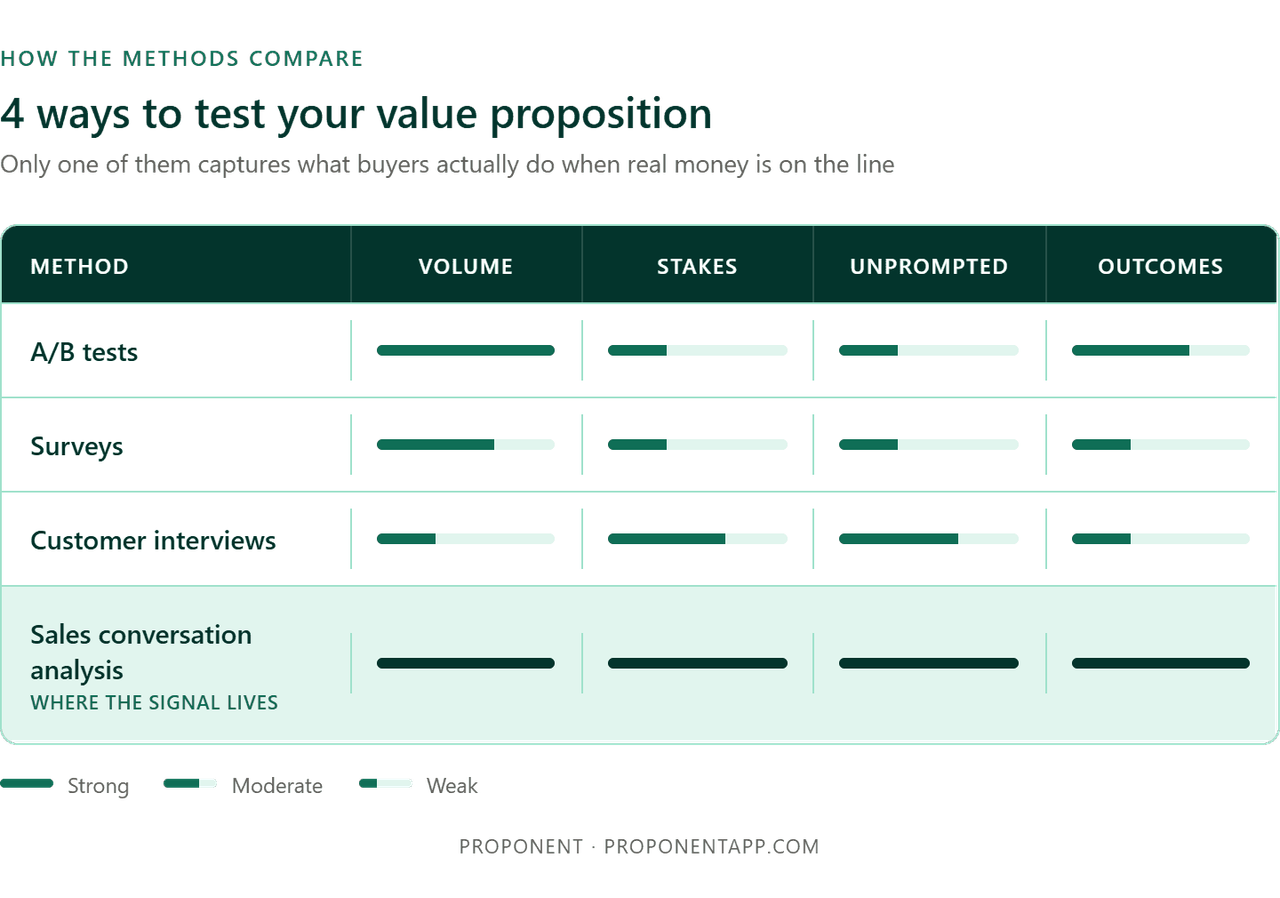
Stakes are real
On a sales call, buyers are evaluating whether to spend real budget on your product. That context produces honest feedback. They don't softball objections to be polite. They don't pretend to understand when they don't. They push back, ask specific questions, and reveal what actually matters to them.
Feedback is unprompted
The best signal in conversations isn't what buyers say when asked. It's what they volunteer. When a buyer interrupts the demo to ask about a specific capability, that's a signal. When they repeat your value prop back to their internal team incorrectly, that's a signal. When they describe their problem in language completely different from your website copy, that's a signal.
None of this shows up in surveys or A/B tests.
Volume is high
Most B2B teams do hundreds of sales calls per month. Compared to the 15 interviews a research study produces or the few thousand form submissions an A/B test might generate, conversation data offers dramatically more volume of high-fidelity signal.
Outcomes are measurable
Unlike survey responses or interview quotes, sales conversations have real outcomes attached. Deal won. Deal lost. Segment. Deal size. Sales cycle length. That means you can correlate messaging patterns with actual business results — which no other form of value proposition testing can do at scale.
What to Test in Sales Conversations
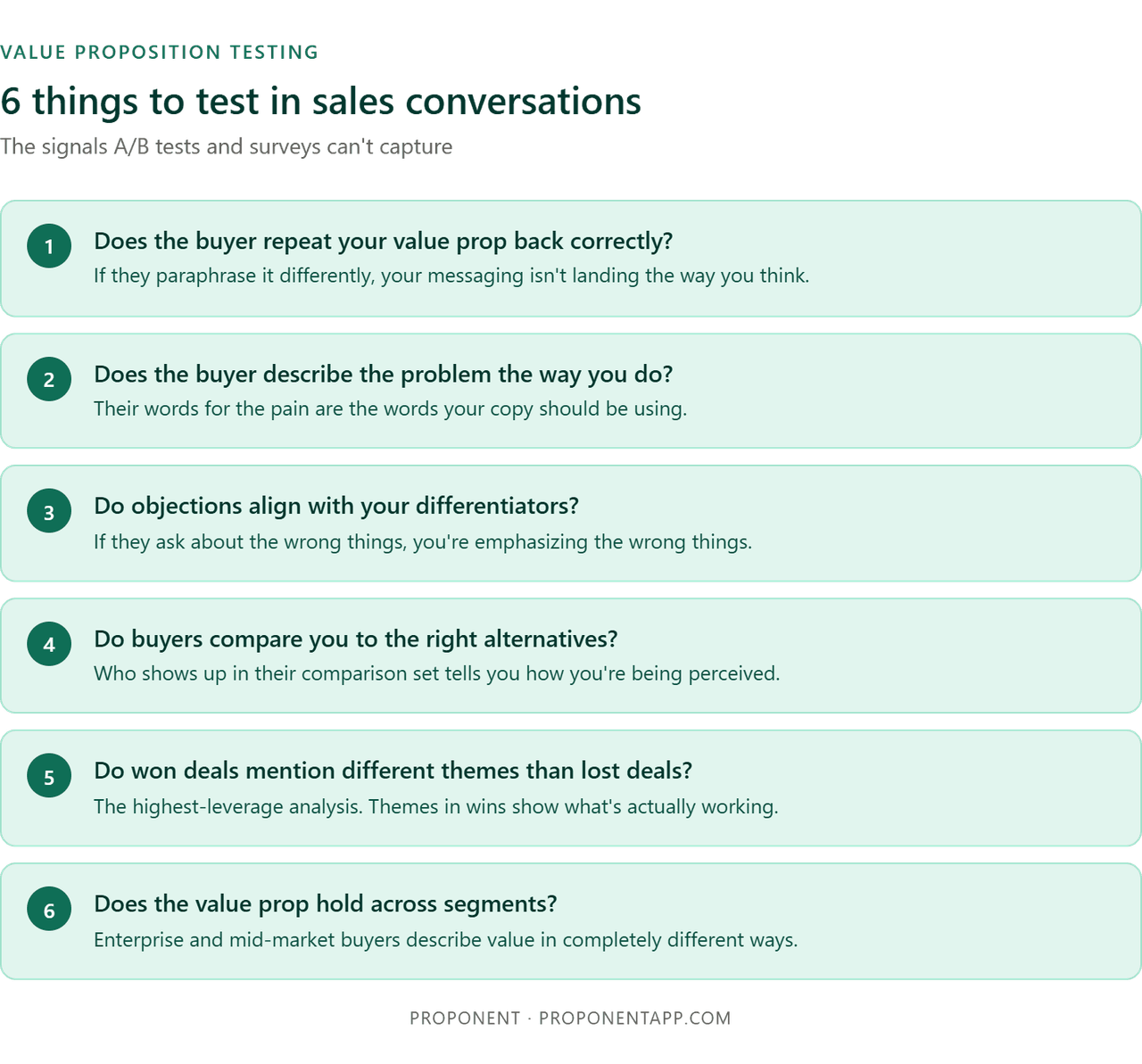
Here's what to look for when using sales conversations as a value proposition testing ground.
1. Does the buyer repeat the value proposition back correctly?
When a buyer summarizes what they think your product does, pay attention to the language they use. If they describe it the way you do, your messaging is landing. If they describe it differently — or incorrectly — your messaging is getting lost or misinterpreted.
Look for: paraphrases from buyers during discovery or follow-up calls. Compare what they say to your positioning document. If there's a gap, your messaging needs tightening.
2. Does the buyer articulate the problem the way you do?
Your value proposition implicitly assumes a specific problem framing. If buyers describe the problem differently than your messaging does, you have a disconnect. Your website might talk about "customer intelligence gaps." Your buyers might talk about "not knowing why deals are slipping." Those aren't the same thing.
Look for: the specific words buyers use to describe their pain. Track these phrases across many calls. If buyers consistently use different language than your marketing, consider adjusting your copy to match theirs.
3. Do objections align with your differentiators?
If your value proposition is "fastest implementation in the category," buyers should be asking about implementation time. If they're asking about reporting capabilities, your positioning isn't landing the way you think it is.
Look for: patterns in objections and questions. If buyers consistently focus on something you consider secondary, your value prop may be emphasizing the wrong thing for your actual ICP.
4. Do buyers compare you to the right alternatives?
Your value proposition implicitly defines the competitive set. If you position as a "better Gong," you're competing in conversation intelligence. If buyers compare you to Dovetail, you're being perceived as a research tool. This matters beyond messaging — it directly affects the competitive battlecards your team builds.
5. Do won deals mention different themes than lost deals?
This is the highest-leverage analysis. Compare what buyers say in deals you won versus deals you lost. The patterns reveal which parts of your value proposition resonate with buyers ready to buy and which parts don't.
Look for: themes that appear disproportionately in wins. If buyers in won deals consistently mention a specific capability or outcome, that's the part of your value prop that's actually working. Lean into it.
6. Does the value prop hold across segments?
A value proposition that converts enterprise buyers might confuse mid-market buyers. Without segment-level analysis, you miss these patterns.
Look for: how buyers describe your value in different segments. If enterprise buyers talk about "scalable infrastructure" and mid-market buyers talk about "easy to set up," your messaging might need segment-specific variations.
How to Run This Analysis
Testing a value proposition using sales conversations isn't a one-time project. It's an ongoing practice. Here's how to operationalize it.
Start with a specific message to test
Pick one value proposition claim you want to validate. Something specific. Not "we help GTM teams win more deals" — too vague. Something like "buyers choose us because our implementation is faster than Gong's." Now you have something to look for in the data.
Pull relevant conversations
Filter to calls where the relevant topic came up. If you're testing messaging about implementation speed, find conversations that mention implementation, onboarding, or time-to-value. Systematically analyzing 30 targeted calls produces better insight than randomly reviewing 5.
Look for convergent and divergent signals
Convergent signals confirm your value prop is landing. Buyers describe the problem the way you do. Objections match your differentiators. Paraphrases match your positioning. Won deals reinforce your themes.
Divergent signals flag problems. Buyers describe the problem differently. Objections focus on secondary attributes. Competitors get mentioned that don't fit your positioning. Lost deals reveal themes you haven't addressed.
Correlate with outcomes
This is the step A/B tests and surveys can't replicate. Tie the patterns you find back to real outcomes. Are the calls where your value prop landed correctly more likely to close? Is there a specific phrasing that correlates with higher win rates or larger deals? That's the feedback loop traditional testing can't produce.
Iterate on the message
Based on what you find, adjust your value proposition and watch the next batch of calls to see whether the signal changes. Over time, this creates a tighter, more evidence-backed positioning than any A/B test or survey could produce.
When to Use Traditional Testing vs. Conversation Analysis
Both approaches have a role. Use each for what it does best.
Use A/B tests for:
- Top-of-funnel headline and CTA optimization
- Landing page conversion
- Ad copy variations
- Email subject line testing
Use surveys for:
- Quantitative validation of hypotheses you already have
- Benchmark measurement (NPS, satisfaction scores)
- Broad market research across large samples
Use interviews for:
- Deep exploration of a specific hypothesis
- Understanding edge cases
- Customer advisory input on major positioning shifts
Use conversation analysis for:
- Ongoing value proposition validation
- Competitive positioning drift
- Segment-level messaging variance
- Win/loss pattern analysis
- Unprompted buyer language discovery
The teams getting this right in 2026 aren't replacing traditional testing. They're adding conversation analysis as the continuous layer underneath it. A/B tests tell you what converts clicks. Surveys tell you what people say when asked. Interviews tell you what a few people think in depth. Conversation data tells you what hundreds of buyers actually do when real money is on the line.
The Bottom Line
Every sales call your team runs is an unintentional value proposition test. Your reps deliver your positioning. Buyers react. Some lean in. Some push back. Some completely misinterpret what your product does.
Most companies don't capture the lesson. The recordings exist. The transcripts exist. The patterns are there. But without a system to extract them, the test runs every day and nobody reviews the results.
Your value proposition is already being tested in real buyer conversations. The only question is whether your team is looking at the data.
Proponent surfaces exactly these signals automatically from your recorded sales calls — book a demo to see how.


