Win Loss Analysis and Competitive Intelligence: How to Use Sales Conversations to Understand Why You Win and Lose Deals
Your CRM says "Closed Lost: Pricing." Your sales call transcript says the buyer loved the product but could not explain the ROI to their finance team. One of these is actionable. The other is a dropdown.
 Bhumika GohilHead of Revenue14 min read
Win Loss analysis is one of the most strategically valuable exercises a B2B go-to-market team can run. When done well, it reveals why deals close, why they fall through, and what competitive dynamics actually influence buyer decisions.
The problem is that most win loss programs are not done well.
Traditional approaches rely on post-mortem interviews, CRM dropdown fields, and sales rep debriefs. These methods capture a version of what happened, but rarely the full story. Buyers soften feedback in structured interviews. CRM fields compress complex decisions into single-word categories. Sales reps report what they remember, which is not always what actually occurred.
Meanwhile, the most detailed and unfiltered record of why deals are won or lost already exists inside the sales conversations that took place during the evaluation. Every discovery call, product demo, pricing discussion, and competitive comparison is sitting in recorded conversations that most teams never systematically analyze.
This guide covers how B2B teams can use sales conversation data to build a more accurate, scalable, and actionable approach to both win/loss analysis and competitive intelligence.
Why Traditional Win Loss Analysis Falls Short
Win loss analysis has been a recommended practice in B2B sales and product marketing for decades. The standard approach involves interviewing buyers after a deal closes to understand what influenced their decision. Some teams use third-party firms like Clozd or Primary Intelligence to conduct these interviews. Others handle them in-house.
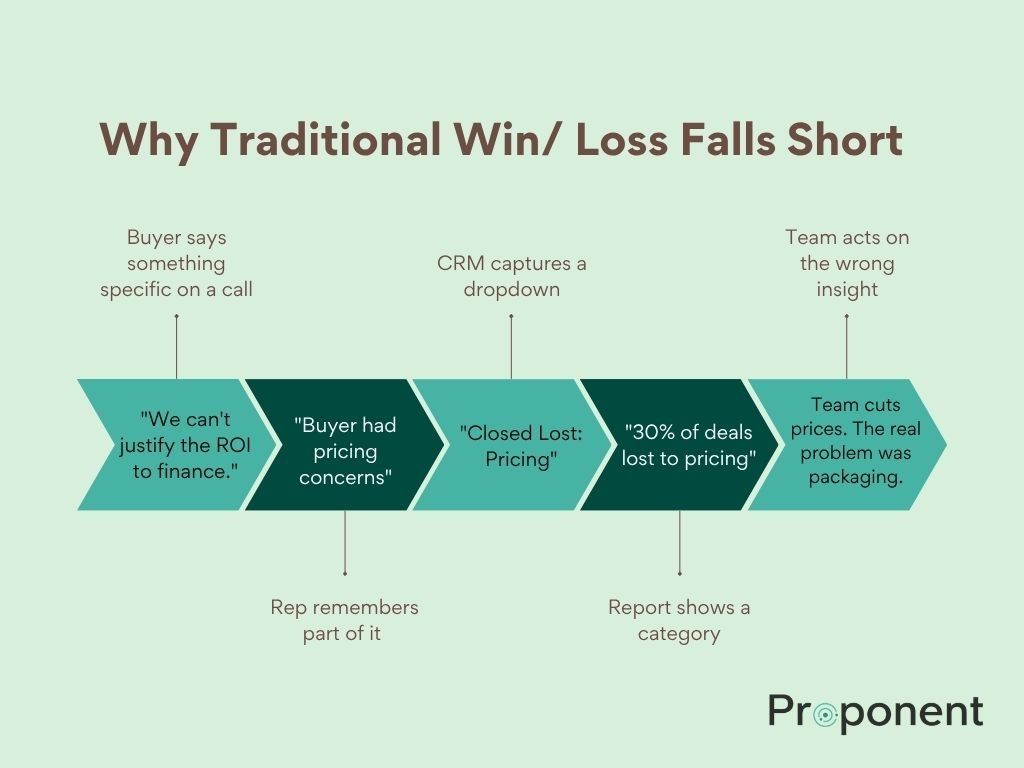
The concept is sound. The execution is where things break down.
1. Post-Mortem Interviews Suffer From Courtesy Bias
When a buyer is asked directly why they did not purchase, they tend to give a polished, professional response. Research consistently shows that buyers provide fully honest feedback in post-mortem interviews less than half the time. Conflict avoidance is a natural human tendency, and it is especially strong when the buyer knows their feedback will be shared with the vendor's team.
A buyer who rejected a product because the pricing felt opaque and the sales rep never followed up with a requested reference will often say "we went in a different direction" or "timing wasn't right." The diplomatic version protects the relationship but provides zero actionable intelligence for the seller.
2. CRM Data Captures Categories, Not Causes
Most CRM systems require sales reps to select a lost reason from a dropdown menu when a deal closes. Common options include "Lost to Competitor," "Pricing," "Timing," or "No Decision."
These fields serve reporting purposes, but they rarely reflect what actually happened. A deal coded as "Lost to Competitor" tells the team nothing about which competitor, what the buyer said about them, or which specific capability or positioning tipped the decision. A deal marked as "Pricing" does not distinguish between a buyer who thought the product was too expensive and a buyer who could not figure out how to justify the investment to their finance department.
The gap between what a CRM dropdown captures and what actually happened during a sales cycle is significant. Teams that rely exclusively on CRM data for win/loss insights are working with summaries of summaries.
3. Sales Rep Feedback Is Filtered by Perspective
Sales representatives are valuable sources of deal intelligence, but their perspective is inherently limited. Reps interact with a subset of the buying group. They hear objections that are voiced directly to them but miss internal discussions that happen without vendor participation.
Additionally, reps naturally interpret deal outcomes through their own experience. A rep who lost a deal may attribute it to pricing because that was the last topic discussed, even though the buyer's internal hesitation was actually about implementation complexity or lack of confidence in the vendor's support model.
None of this means CRM data, rep feedback, or post-mortem interviews are useless. They are valuable inputs. But they are insufficient when used as the sole basis for understanding why deals are won and lost.
How Sales Conversation Data Changes Win Loss Analysis
Every B2B sales cycle generates a series of recorded conversations. Discovery calls, product demonstrations, pricing discussions, security reviews, and follow-up sessions. These recordings contain the actual words buyers used to describe their problems, evaluate alternatives, raise objections, and express hesitation.
When analyzed systematically, this conversation data provides a fundamentally different view of why deals succeed or fail.
1. Conversations Reveal the Real Objections
A CRM field might indicate that a deal was lost due to "Missing Features." The actual sales conversation might reveal something very different.
In one analysis, a team discovered that deals marked as feature gaps in the CRM were actually lost because of technical friction. Buyers described issues like fragile data associations between meetings and CRM records, attachment syncing failures, and messy data that made adoption feel risky. These are not missing features. They are implementation and integration concerns that require entirely different responses from the product and sales teams.
This distinction matters because the corrective action for "missing features" (build more features) is completely different from the corrective action for "technical friction" (improve data reliability and integration stability).
2. Conversations Show Where Execution Breaks Down
One of the most valuable and underutilized applications of conversation data in win/loss analysis is identifying sales execution gaps.
Post-mortem interviews cannot capture these gaps because buyers are often unaware of internal breakdowns on the seller's side. A buyer does not know that the sales rep had a case study available but never sent it. They do not know that a technical resource was supposed to join a call but was never scheduled. They simply know that their questions went unanswered and their confidence eroded.
Analyzing the actual conversation record reveals these moments clearly. Teams can identify patterns such as follow-up commitments that were never fulfilled, decision-makers who were never engaged, or pricing discussions that ended with ambiguity rather than clarity.
For sales enablement teams, this type of insight is particularly valuable. It reveals the gap between what resources exist and what resources are actually deployed during live sales interactions.
3. Conversations Capture the Buying Group Dynamic
Modern B2B buying decisions involve an average of 13 internal stakeholders and 9 external influencers, according to Forrester's 2026 State of Business Buying report. That means more than 20 people can influence a single purchase decision.
A sales rep typically interacts with a fraction of this group. CRM records reflect an even smaller slice. But across a series of recorded conversations within a deal, patterns emerge about which stakeholders are engaged, what concerns each raises, and where alignment breaks down within the buying committee.
This level of visibility is nearly impossible to reconstruct from post-mortem interviews or CRM data alone.
Building Competitive Intelligence From Buyer Conversations
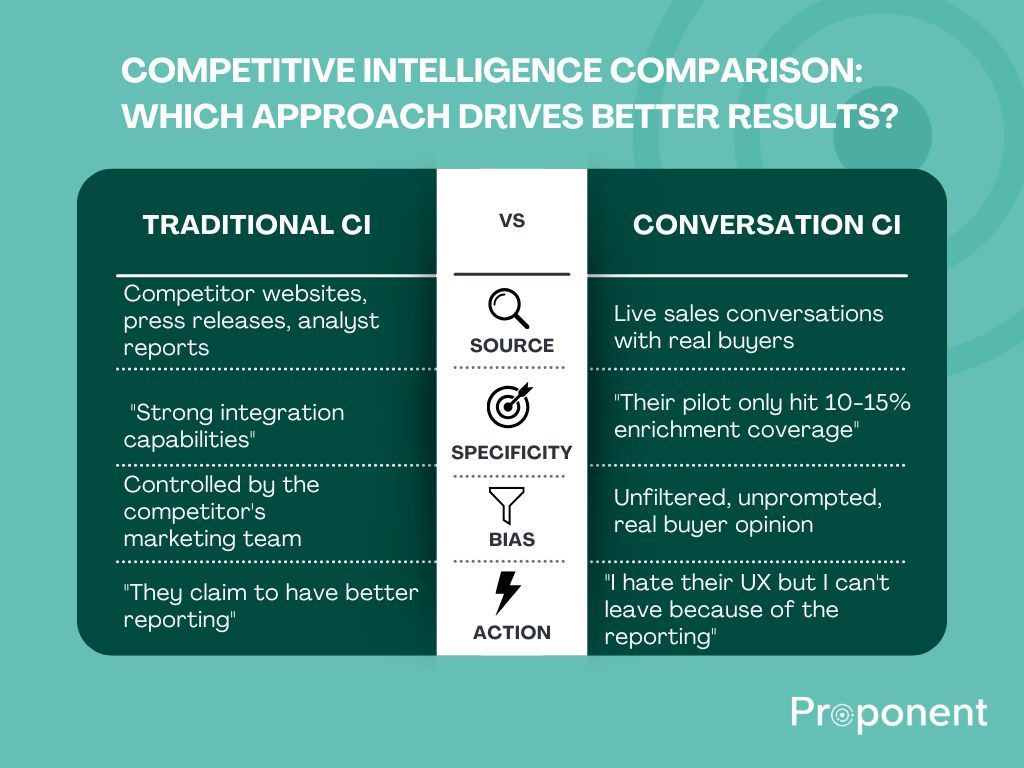
Win/loss analysis and competitive intelligence are closely related disciplines. Understanding why deals are won and lost almost always involves understanding how buyers perceive and compare competitive alternatives.
Traditional competitive intelligence programs rely on publicly available information. Competitor websites, analyst reports, press releases, job postings, and pricing pages. Tools like Klue, Crayon, and Kompyte aggregate these external signals to help teams track what competitors are doing.
This approach has value, but it captures what competitors say about themselves. It does not capture what buyers say about competitors.
1. What Buyers Actually Say About Competitors
When buyers evaluate multiple vendors, they naturally compare them during sales conversations. They describe what they liked about a competitor's demo. They explain why a previous tool failed. They share pricing details they received from other vendors. They articulate the specific reasons they are considering switching.
This information is extraordinarily valuable for competitive positioning, but it rarely makes it into structured competitive intelligence programs. It lives in individual call recordings, heard by individual reps, and mentioned in passing during pipeline reviews.
When conversation data is analyzed across multiple deals, patterns emerge that transform competitive intelligence from anecdotal to systematic.
For example, a team might discover that a specific competitor is consistently mentioned in lost mid-market deals, and that buyers describe that competitor's advantage not in terms of features but in terms of reporting capabilities that are difficult to replace. That insight reshapes how the team positions against that competitor far more effectively than any competitor website analysis could.
2. Competitive Battlecards Built From Real Buyer Language
One of the most common outputs of competitive intelligence is the battlecard, a sales enablement document designed to help reps navigate competitive situations. Research consistently shows that a majority of marketing-created sales content goes unused by sales teams. Battlecards are frequently among the most ignored assets.
The primary reason is relevance. Battlecards built from internet research and internal assumptions address objections that marketing expects buyers to raise, not the objections buyers actually raise. When battlecard content does not match the reality of sales conversations, reps stop using it.
Conversation data solves this problem directly. By analyzing what buyers actually say about competitors during recorded calls, teams can build battlecards that address the real objections, use the buyer's own language, and provide responses that have been validated against actual deal outcomes.
A battlecard built from real buyer transcripts answers different questions than one built from competitor website analysis. Instead of addressing what the competitor claims to do, it addresses what buyers believe the competitor does, what frustrates them about their current tool, and what would need to be true for them to switch.
If you're ready to put this into practice, we walk through the full process for turning buyer language into usable enablement content in How to Build Competitive Battlecards in 7 Steps (That Sales Teams Actually Use).
3. Tracking Competitive Trends Over Time
Point-in-time competitive analysis provides a snapshot, but markets shift continuously. New competitors enter. Existing competitors change pricing. Buyer perceptions evolve as products improve or deteriorate.
Conversation data provides continuous competitive signal. As new sales conversations are recorded and analyzed, teams can track how frequently specific competitors are mentioned, whether sentiment toward competitors is shifting, and which new players are beginning to appear in evaluation discussions.
This continuous monitoring is difficult to achieve through traditional competitive intelligence methods, which typically involve periodic research sprints rather than ongoing signal capture.
Combining Win Loss Analysis and Competitive Intelligence: A Practical Framework
The most effective approach treats win/loss analysis and competitive intelligence as interconnected disciplines powered by the same underlying data source: recorded sales conversations.
Step 1: Connect Conversation Data to Deal Outcomes
The foundation is linking recorded conversations to CRM deal records. This connection enables analysis by outcome. Specifically, it becomes possible to compare what was discussed in won deals versus lost deals, filtered by segment, deal size, competitor involvement, or any other CRM dimension.
Without this connection, conversation data remains a collection of individual recordings. With it, the data becomes a structured intelligence asset.
Step 2: Identify Patterns in Won Deals
Analyzing won deals reveals what is working. Common patterns in won deal conversations include clear articulation of the problem the product solves, specific use cases that matched the buyer's workflow, pricing discussions that ended with clarity rather than ambiguity, and competitive comparisons where the product was clearly differentiated.
These patterns inform messaging, sales playbooks, and customer success onboarding.
Step 3: Identify Patterns in Lost Deals
Lost deal analysis often produces the most actionable insights. Common patterns include objections that appeared repeatedly across multiple lost deals, specific competitors that were mentioned in losses but not in wins, pricing discussions where buyers expressed confusion or hesitation, and decision-makers who were never engaged during the sales process.
These patterns inform product development priorities, pricing strategy, sales training, and competitive positioning.
Step 4: Extract Competitive Intelligence by Segment
Different market segments often have different competitive dynamics. The competitor that dominates enterprise evaluations may be irrelevant in the mid-market. The objection that kills deals in regulated industries may never appear in technology companies.
Analyzing conversation data by segment reveals these differences and enables targeted competitive strategies rather than one-size-fits-all battlecards.
Step 5: Build Feedback Loops That Update Continuously
The most valuable win/loss and competitive intelligence programs are not periodic research projects. They are continuous feedback systems where new data from every sales conversation feeds back into positioning, enablement content, and product strategy.
When conversation analysis is embedded into weekly workflows rather than quarterly research sprints, insights compound over time. The team develops a progressively more accurate understanding of buyer behavior, competitive dynamics, and deal patterns.
What Makes Conversation-Based Win Loss Analysis Different
Traditional win/loss analysis is limited by what buyers are willing to say after the fact. Conversation-based analysis captures what buyers actually said while the decision was being made.
The distinction is significant across several dimensions.
1. Spontaneous vs. Prompted Feedback
Post-mortem interviews capture prompted responses. Buyers answer questions that the interviewer asks, which means the insights are constrained by the interviewer's assumptions about what to ask.
Sales conversations capture spontaneous responses. Buyers volunteer information about their problems, their evaluation criteria, and their perceptions of competitive alternatives without being prompted. This often surfaces insights that a structured interview would never uncover.
2. Continuous vs. Point-in-Time
Interviews and surveys provide snapshots taken at a single moment after the deal closes. Conversation data provides a continuous record of how buyer sentiment evolved throughout the sales cycle. This makes it possible to identify the specific moment where a deal started to go off track, not just the final outcome.
3. Scalable vs. Resource-Intensive
Traditional win/loss interviews require significant time and resources per deal. Whether conducted in-house or through a third-party firm, each interview involves scheduling, conducting the conversation, transcribing, and analyzing the results. This limits most programs to a small sample of deals.
Conversation analysis scales across every recorded interaction. When supported by AI-powered tools, teams can analyze patterns across hundreds or thousands of conversations without increasing the time investment per deal.
4. Behavioral vs. Attitudinal
Surveys and interviews capture what buyers say they think and feel. Conversation data captures what they actually do during an evaluation. The hesitations in their voice. The questions they return to repeatedly. The competitors they bring up unprompted. The specific moment they shift from exploratory to serious.
This behavioral layer adds a dimension of insight that attitudinal research methods cannot access.
Getting Started: Practical Steps for B2B Teams
Organizations looking to build a conversation-based approach to win/loss analysis and competitive intelligence can begin with a focused pilot rather than a company-wide transformation.
1. Start With Recent Lost Deals
Select 10 to 15 recently lost deals that had multiple recorded conversations. Analyze the transcripts to identify the most common objections, competitive mentions, and points where buyer sentiment appeared to shift. Compare what the transcripts reveal with what the CRM records indicate. The gap between these two sources of information typically demonstrates the value of conversation analysis more effectively than any theoretical argument.
2. Involve Product Marketing Early
Product marketing teams are the primary consumers of win loss and competitive intelligence, yet they are often excluded from conversation data. Giving PMMs direct access to buyer conversation insights transforms their ability to validate positioning, build relevant competitive content, and influence product strategy with evidence rather than assumptions.
To make this a repeatable habit rather than a one-off project, many PMM teams build a standing set of reports from this data—see the ones we recommend in 5 Customer Intelligence Reports Every PMM Should Run Monthly.
3. Tag Conversations to CRM Outcomes
The analytical power of conversation data increases significantly when it is connected to business context. Linking conversations to deal outcomes, deal stages, buyer personas, and market segments enables the kind of cross-conversation pattern analysis that surfaces strategic insights rather than anecdotal observations.
4. Build a Weekly Review Habit
The teams that extract the most value from conversation data embed it into their weekly operating rhythm rather than treating it as a quarterly research project. A 15-minute weekly review of emerging patterns, combined with a monthly deep dive into competitive dynamics and deal outcomes, creates a feedback loop that continuously improves go-to-market execution.
Why This Matters Now
B2B buying is becoming more complex. Buying groups are expanding. Evaluation cycles are longer. Buyers are more informed and more skeptical. The competitive landscape shifts faster than quarterly research can track.
In this environment, the teams that understand their buyers most deeply will outperform those that rely on assumptions, CRM dropdowns, and polished post-mortem feedback.
The intelligence needed to win is not hidden. It is sitting in recorded conversations, waiting to be analyzed.
The question is whether the teams that need it most are listening.
Proponent builds this kind of win/loss and competitive intelligence automatically from your recorded sales calls — book a demo to see how.


