How to Build Competitive Battlecards in 7 Steps (That Sales Teams Actually Use)
Most competitive battlecards go unused because they're built from internet research, not buyer conversations. This step-by-step guide shows how to build battlecards sales teams actually trust.
 Bhumika GohilHead of Revenue9 min read
Clozd's research has found that 65% of sales content goes unused. Competitive battlecards are often the first casualty. Marketing spends weeks researching competitors, designing templates, and writing talk tracks. Sales opens the document once and never touches it again.
The reason isn't design or distribution. It's that most competitive battlecards are built from the wrong data. They address objections marketing expects buyers to raise, not the objections buyers actually raise. And when the card doesn't match what reps hear in live conversations, they stop trusting it.
This guide covers how to build competitive battlecards in 7 clear steps, including the one most guides skip entirely: building them from what buyers say about your competitors during real sales conversations.
What Is a Competitive Battlecard?
A competitive battlecard is a concise, actionable document that helps sales reps navigate conversations when a competitor comes up during a deal. It typically covers who the competitor is, where you win, where they win, how to handle common objections, and what proof points to reference.
When done well, battlecards improve win rates, shorten sales cycles, and give reps confidence in the moments that matter most. However, when done poorly, they sit in a shared drive gathering dust while reps rely on memory and guesswork instead.
The difference between a battlecard that gets used and one that gets ignored almost always comes down to one thing: whether the content matches what reps actually encounter in competitive deals.
Why Most Competitive Battlecards Don't Get Used
Before building a better battlecard, it's worth understanding why existing ones fail. There are four common reasons.
Built from the wrong sources
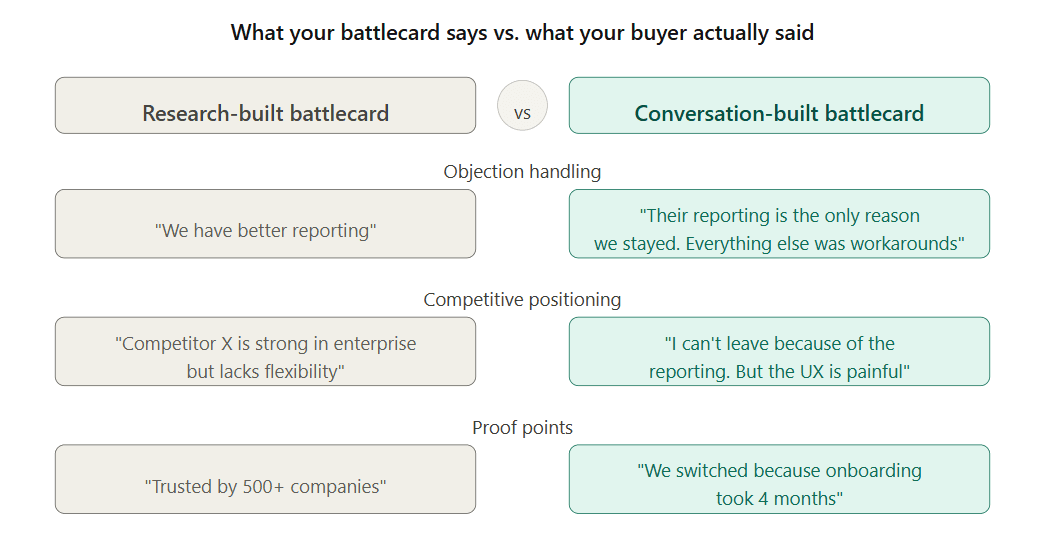
The standard process starts with competitor websites, G2 reviews, analyst reports, and pricing pages. This tells you what competitors say about themselves. It does not tell you what buyers say about competitors. There's a significant gap between the two.
A competitor's website might emphasize "enterprise-grade reporting." Meanwhile, your buyers describe that same reporting as "the only reason I haven't switched, even though their UX is terrible." One gives you a feature to counter. The other gives you a deal-winning insight.
Address the wrong objections
Battlecards built from internal assumptions anticipate objections marketing thinks will come up. The objections buyers actually raise are often different. Marketing expects pricing pushback. The real blocker might be implementation complexity, a specific integration gap, or the buyer's inability to build an internal business case. Research from Clozd found that CRM closed-lost reasons are wrong 85% of the time. If your battlecard is built on those same assumptions, it's addressing the wrong problems.
Static in a dynamic market
A battlecard built from a quarterly research sprint is outdated within weeks. Competitive landscapes shift constantly. New features launch, pricing changes, and buyer perceptions evolve. Reps learn to distrust content that doesn't match what they hear in live conversations. Additionally, Gartner research has found that a majority of B2B buyers now prefer little to no interaction with a sales rep for at least part of their buying journey, which means the few conversations reps do have carry even more weight. The intelligence from those conversations needs to be captured and used.
Too long or too generic
If a battlecard takes more than 60 seconds to scan, it won't get used mid-call. If it applies to every deal equally, it helps in none of them specifically. The best battlecards are concise enough to skim in 10 seconds and specific enough to address the exact competitive situation a rep is facing.
7 Steps to Build Competitive Battlecards That Actually Work
Step 1: Identify Your Top Competitors by Deal Frequency
Don't build battlecards for every competitor in your market. Start with the 3-5 that actually appear in your pipeline. Check your CRM data, but also ask reps directly. The competitors showing up in conversations are not always the same ones your CRM tracks. Moreover, some "competitors" in your CRM may actually be the status quo or no-decision outcomes, which require a completely different type of card.
Step 2: Define What Every Battlecard Should Include
Every competitive battlecard needs these seven components:
Competitor overview: Who they are, their positioning, and their primary market. Keep it to 3-4 sentences. Reps need context, not a research paper.
Where you win: The specific scenarios, use cases, or buyer profiles where your product is clearly the better fit. This should not be a feature checklist. Instead, describe the situations where you consistently outperform, backed by evidence from real deals.
Where they win: An honest assessment of their strengths. This section builds trust. Reps who acknowledge where a competitor is genuinely strong earn more credibility than reps who claim to be better at everything. Buyers respect honesty, and it positions the rep as a trusted advisor rather than a salesperson.
Common objections and responses: The specific objections buyers raise when comparing you to this competitor, paired with talk tracks for each. This is the section where most battlecards fail because the objections listed are assumed rather than observed.
Landmine questions: Questions your reps can suggest buyers ask the competitor during their evaluation. These should highlight areas where the competitor is weak or where your product has a clear advantage. Effective landmines put the competitor in a position where any honest answer works in your favor.
Pricing guidance: How the competitor typically prices, common discounts they offer, and where you deliver more value. Include negotiation guidelines so reps know what levers they can pull.
Proof points: Customer quotes from buyers who evaluated both options and chose you. Social proof from someone who compared you head-to-head and picked you is the most powerful content a battlecard can contain.
Step 3: Gather Standard Competitive Research
Start with the sources every guide recommends: competitor websites, G2 and Gartner reviews, analyst reports, pricing pages, job postings, and press releases. This gives you baseline knowledge about positioning, features, and market perception.
Talk to your sales reps about what they hear most often. Talk to customer success about why customers switched from competitors. Talk to product about where the roadmap addresses competitive gaps. This internal intelligence is valuable and should inform the card.
However, recognize that all of this is secondhand. It's filtered through public positioning, selective memory, and polished reviews. It's a starting point, not the full picture.
Step 4: Build From Buyer Conversations (The Step Most Guides Skip)
This is where competitive battlecards go from generic to genuinely useful.
The most accurate competitive intelligence lives in the actual sales conversations where buyers describe their experience with your competitors. Unprompted, unfiltered, with real money on the line. Therefore, this data is fundamentally different from what you find through internet research.
It's unfiltered. Buyers aren't writing a public review. They're describing their honest experience in a private conversation with your sales team.
It's specific. Instead of "Competitor X has good reporting," you hear "Their reporting is the only thing keeping us. But we spend 3 hours a week on workarounds for everything else." That level of specificity tells you exactly how to position against them.
It's current. A buyer talking about a competitor on today's call is describing today's reality. Not last quarter's G2 review or last year's analyst report.
It uses the buyer's language. The way buyers describe competitors is different from how competitors describe themselves and different from how your marketing team talks about them. Buyer language is the most effective language for battlecards because it matches how future buyers think and speak.
To extract this intelligence, don't analyze individual calls. Analyze patterns across many conversations. Track which competitors are mentioned most and in which segments. Identify how buyers describe each competitor's strengths and weaknesses. Compare competitive mentions in won deals versus lost deals. If a competitor appears in 70% of your losses in a segment but only 20% of wins, your positioning for that segment needs work. Capture the exact language buyers use. When a buyer says "I can't leave because of the reporting layer," that phrase belongs in your battlecard verbatim.
Step 5: Map Conversation Data to Each Battlecard Section
Once you've extracted competitive patterns from sales conversations, the battlecard sections write themselves:
Where you win comes from what buyers in won deals said about why they chose you over this competitor.
Where they win comes from what buyers in lost deals said about why they chose the competitor instead.
Common objections come from the actual objections that appeared across multiple deals, ranked by frequency. Not assumed objections. Real ones.
Proof points come from buyer quotes in won deals where the buyer explicitly described why your product was the better fit for their use case.
Landmine questions come from areas where buyers consistently described frustration with the competitor. If multiple buyers independently complained about the competitor's onboarding timeline, a question like "How long did they say implementation would take?" becomes a powerful landmine.
This approach also connects directly to your broader sales data analysis process. The same conversation data that informs win/loss patterns also feeds your competitive battlecards.
Step 6: Keep Battlecards Current
A competitive battlecard is only useful if it reflects what's happening now. Instead of quarterly research sprints, build a system where every new sales conversation that mentions a competitor feeds fresh signal into your battlecards.
Update based on deal outcomes. Every lost deal tells you what to fix. Every won deal tells you what's working. This creates a feedback loop where each deal makes the battlecard more accurate over time.
Track shifts in buyer sentiment. If buyers start describing a competitor more positively or more negatively than they did three months ago, your battlecard needs to reflect that change.
Monthly review cadence. Even with continuous data flowing in, review each card monthly to check whether top objections have shifted and whether new competitors are emerging. The customer voice gap widens fastest when competitive intelligence isn't continuously refreshed.
Step 7: Measure and Iterate
Building the battlecard is only half the job. Measuring whether it works is equally important.
Usage: Track how frequently reps access each battlecard. Low usage means it's either not needed or not useful enough for reps to bother opening.
Competitive win rate: Measure your win rate in deals involving each specific competitor. Track this over time. If your win rate against a competitor improves after a battlecard update, the update is working.
Rep feedback: Ask reps directly. Does this help in live conversations? What's missing? What's outdated? What objections are you hearing that aren't covered? Reps are the end users of battlecards. Their feedback is the most important signal you have.
Getting Started
Pick your top 3 competitors by deal frequency. Pull the last 20 deals where each was mentioned. Analyze what buyers actually said about them in those conversations. Then compare that with what's currently in your battlecards.
The gap between the two will show you exactly why conversation-built battlecards outperform research-built ones.
Build from the source, and your reps will trust the card.


