Do You Need a Dedicated Conversation Intelligence Tool, or Is Your CRM's Native Feature Enough?
Salesforce, HubSpot, and Dynamics 365 all ship native conversation intelligence. Here's what it actually does, what it doesn't, and when you need more.
 Bhumika GohilHead of Revenue8 min read
Salesforce, HubSpot, and Microsoft Dynamics 365 all ship a native conversation intelligence feature: call recording, transcription, sentiment, and keyword tracking, built into the CRM you already pay for. What none of the three do out of the box is score a deal against a qualification framework like MEDDPICC, or coach every rep on every call across a CRM stack that isn't just their own. Whether the native feature is enough for your team comes down to which of those two things you actually need.
What Native Conversation Intelligence Actually Does
All three major CRMs have put real investment into this category, not bolted it on as an afterthought. Here's what each one ships, as of mid-2026.
Salesforce's version is Einstein Conversation Insights (ECI), part of Sales Cloud. Spring '26 consolidated call summaries and generative insights into a single "Generative ECI" experience that works across voice and video calls. Enterprise Edition orgs get 10 free ECI licenses, each covering 60 processed call hours a year; Unlimited and Performance Editions get 120 hours a year per license free. Beyond that free allotment, ECI runs $50 to $70 per user per month standalone, or comes bundled with Sales Engagement and Sales Programs, with each license covering up to 675 processed call hours a year, pooled at the org level. It connects to Zoom, Microsoft Teams, Google Meet, Webex, Dialpad, RingCentral, Service Cloud Voice, and Aircall, and it can even ingest Gong transcripts. It tracks up to 100 custom keyword-based insights (25 keywords each), plus, as of Spring '26, up to 8 custom generative insights per call: sentiment trends, pricing or competitor mentions, and talk-to-listen ratio.
HubSpot's Conversation Intelligence lives inside Sales Hub, but only at Professional ($90 to $100 per seat per month) or Enterprise ($150 per seat per month); it isn't part of Starter or the free CRM. Professional accounts get 750 hours of call transcription per account per month; Enterprise gets 1,500. It records and transcribes calls made through HubSpot's own calling tool, Zoom, Google Meet, JustCall, Kixie, and other App Marketplace integrations, and automatically associates each recording with the right contact, company, and deal record.
Microsoft's version sits inside Dynamics 365 Sales, gated behind the Sales Enterprise ($105 per user per month, list price) or Sales Premium ($150-plus per user per month) tier; the base Sales Professional plan, at $65 per user per month, doesn't include it. It transcribes calls, flags sentiment, competitor mentions, and tracked keywords, and logs a summary with suggested follow-ups back into the CRM record. Two constraints worth knowing before planning around it: it only processes stereo-channel recordings (mono-channel files are explicitly unsupported), and it needs at least 10 call recordings on hand before it starts processing and displaying data at all, with up to a 12-hour lag before that data shows up.
| What it does | Tier or license required | Notable constraint | |
|---|---|---|---|
| Salesforce Einstein Conversation Insights | Call transcription, sentiment, keyword and competitor tracking, AI call summaries | Free allotment on Enterprise/Unlimited/Performance Editions; $50-70/user/mo beyond that or bundled with Sales Engagement/Programs | Free hours are capped per license (60-120 hrs/yr); paid tier caps at 675 hrs/yr per license, pooled |
| HubSpot Conversation Intelligence | Call recording, transcription, automatic CRM association, coaching insights | Sales Hub Professional ($90-100/seat/mo) or Enterprise ($150/seat/mo) only | Account-wide transcription cap: 750 hrs/mo (Professional) or 1,500 hrs/mo (Enterprise) |
| Dynamics 365 Sales conversation intelligence | Transcription, sentiment, competitor/keyword flags, CRM-logged summaries | Sales Enterprise ($105/user/mo) or Sales Premium ($150+/user/mo); not on base Professional | Stereo recordings only; needs 10+ calls on hand before it processes; up to 12-hr data lag |
What Native Conversation Intelligence Doesn't Do
Everything above is real, shipped functionality, not vaporware. Two gaps are worth being specific about, because they're the ones that actually decide whether the native feature is enough.
None of the three native features score a deal against a named qualification framework. Salesforce's ECI, HubSpot's CI, and Dynamics 365's CI all extract keyword mentions, sentiment, and talk ratios from a call, but turning "objection raised" or "competitor named" into a structured, auditable deal-health score against MEDDPICC or BANT criteria isn't part of what any of them ship out of the box. Flagging that a word got said and scoring whether a deal is actually qualified are different problems.
Native also doesn't mean included. All three gate conversation intelligence behind a specific license tier, usually the one above where most teams start: Salesforce's free allotment runs out fast on a team of any real size, HubSpot requires Professional or Enterprise Sales Hub, and Dynamics 365 requires Sales Enterprise or Premium over the base Professional plan. Budgeting for "the CRM we already have" and budgeting for "the CRM tier with conversation intelligence turned on" are two different numbers, and it's worth checking which one your current plan actually is before assuming the feature is already paid for.
A native feature also only sees the CRM it lives inside. If your team runs more than one CRM, is mid-migration, or has different business units on different platforms, the call intelligence doesn't travel with you. That's just how the architecture is scoped.
Native Feature vs. Dedicated Platform, Side by Side
| Dimension | Native CRM feature (Salesforce, HubSpot, Dynamics 365) | Dedicated platform (Proponent) |
|---|---|---|
| Qualification-framework scoring | Keyword and sentiment tracking; no built-in MEDDPICC/BANT scoring | Every deal scored against MEDDPICC or your own framework, traceable to the call moment |
| CRM write-back | Writes back to the one CRM it's built into | Writes to HubSpot, Salesforce, Zoho, Attio, or Pipedrive |
| Coaching coverage | Bounded by license hour caps and per-seat licensing | Scores calls at scale, not just the ones a manager reviews live |
| Pricing model | Per seat, on top of the CRM tier that unlocks it | By call volume, unlimited seats included |
| Cost to unlock | Requires upgrading to a specific CRM tier (often the top one) before the feature is even available | Available on its own, independent of what CRM tier you're running |
When the Native Feature Is Actually Enough
The honest answer is: sometimes it is. The native feature is a reasonable fit if:
- Your team runs a single CRM with no plans to switch or consolidate
- The team is small enough that a manager can still realistically sit in on or review most calls live
- What you actually want is searchable, transcribed call recordings, not a structured deal score
- You're already paying for the tier that includes it (Salesforce Unlimited, HubSpot Enterprise, Dynamics Premium), so there's no incremental cost to turn it on
In that scenario, it's hard to justify paying extra for a dedicated platform to do a job your CRM already does.
When You Need a Dedicated Tool
The case for a dedicated platform gets stronger as soon as one of these is true:
- You want deals scored against a real qualification framework like MEDDPICC, not just flagged for keyword mentions. What is revenue intelligence covers how that scoring layer works in more depth.
- Your team runs a mixed CRM stack, or a CRM without a comparable native feature, such as Zoho, Attio, or Pipedrive.
- You need coaching on every call, not just the ones a manager has time to review, since native tools are still bounded by who's watching, not just what's recorded.
- You'd rather pay for call volume than pay more every time the team hires a new rep.
If you're weighing a dedicated conversation intelligence vendor against your CRM's native feature, Gong vs Proponent is a useful next read for how two dedicated platforms differ from each other, once you've decided native isn't enough.
What This Actually Costs
Run the numbers side by side and the shape of the decision gets clearer. Proponent prices by call volume for the whole org: Starter is $149/mo for 500 calls, Growth is $399/mo for 1,500 calls, Scale is $999/mo for 4,000 calls, Team is $2,299/mo for 10,000 calls, and Enterprise is custom, starting from $0.20 per call. Every tier includes unlimited seats.
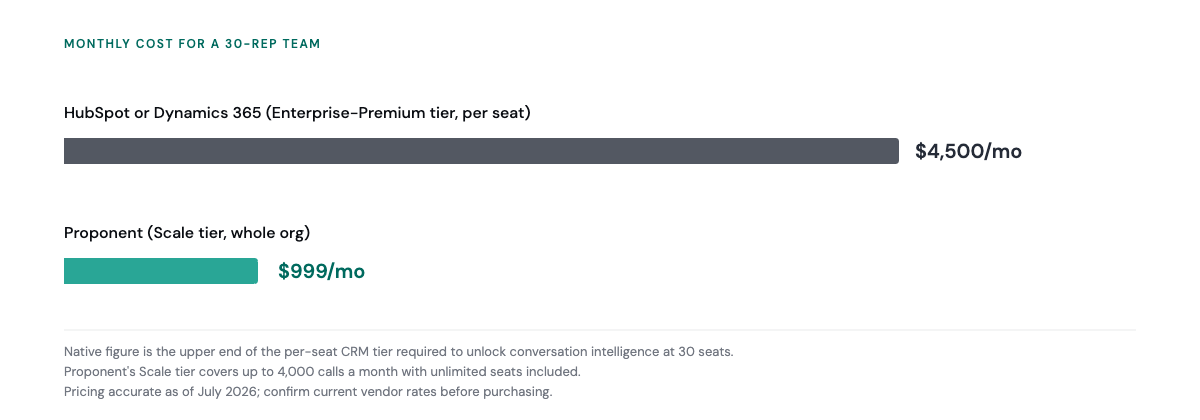
A 30-rep team is a useful sizing check. The CRM tier required to unlock native conversation intelligence for that many seats runs up to $4,500 a month, on top of the base CRM subscription those seats already need. Proponent's Scale tier covers the same team at $999 a month, whole org included.
| Team size | HubSpot or Dynamics 365 tier that unlocks CI (per seat) | Proponent (whole org, call volume) |
|---|---|---|
| 5 reps | $450-750/mo | $399/mo (Growth tier) |
| 30 reps | $2,700-4,500/mo | $999/mo (Scale tier) |
| 100 reps | $9,000-15,000/mo | ~$2,660/mo (Enterprise, custom) |
Estimates: ~133 calls/rep/month against Proponent's call-volume tiers vs. $90-150/seat/month for HubSpot Sales Hub Professional through Enterprise, or $105-150+/seat/month for Dynamics 365 Sales Enterprise through Premium. Salesforce isn't in this table because its ECI hours can be free within an Enterprise, Unlimited, or Performance Edition's included allotment, which makes a direct per-seat comparison misleading below that usage threshold; teams that exceed the free hours pay $50-70/user/month on top.
That comparison only accounts for the seats a native feature is licensed per; it doesn't include whatever the base CRM subscription already costs underneath it, which the native tier requires regardless. The full pricing breakdown has the exact tiers.
None of this makes the native feature a bad choice for the team it fits. It makes it worth doing the actual math, tier by tier, before assuming "native" and "free" mean the same thing. If deal scoring against a real qualification framework and CRM-wide coaching coverage are what you're actually after, booking a walkthrough is the fastest way to see how that holds up against your own calls.
Frequently asked questions
Does Salesforce's native conversation intelligence do MEDDPICC-style deal scoring?
No. Einstein Conversation Insights tracks keywords, sentiment, competitor mentions, and talk-to-listen ratio, but it doesn't natively score a deal against a qualification framework like MEDDPICC or BANT. That kind of structured, auditable scoring is a separate capability from keyword tracking.
Is HubSpot's Conversation Intelligence free?
No. It's only available on Sales Hub Professional ($90-100 per seat per month) or Enterprise ($150 per seat per month), not on Starter or the free CRM. Each tier also caps total account-wide transcription hours per month.
Can Dynamics 365 conversation intelligence work with a dialer besides Microsoft Teams?
Yes, it works with any telephony system, but only if the call recordings are stereo-channel; mono-channel recordings aren't processed. It also requires at least 10 call recordings on hand before it starts displaying data.
What does native conversation intelligence actually cost, beyond the CRM license?
It depends on the platform, but in all three cases the feature is gated behind a specific tier, often the top one, of the CRM you're already paying for. Salesforce's free allotment is capped in hours per license, HubSpot requires Professional or Enterprise Sales Hub, and Dynamics 365 requires Sales Enterprise or Premium over the base plan, so the real cost is usually the gap between the tier you're on and the tier that includes it.
Can I use a dedicated conversation intelligence tool alongside my CRM's native feature?
Yes. A dedicated platform like Proponent connects to the CRM you already use (HubSpot, Salesforce, Zoho, Attio, or Pipedrive) and to whatever recorder or dialer your team already has, so it can run alongside a native feature during evaluation rather than requiring you to turn the native one off first.
Does a dedicated platform like Proponent replace my CRM?
No. It writes into the CRM you already use rather than replacing it, updating deal records, scores, and coaching notes automatically from each call instead of adding a second system reps have to check separately.
What's the difference between conversation intelligence and revenue intelligence?
Conversation intelligence is about a single call: what was said, by whom, and what the sentiment was. Revenue intelligence sits on top of that call-level data and ties it to deal stage, rep performance, and forecast accuracy across the whole pipeline, which is the layer sales leadership actually uses to run the business.
Can I switch from a native CRM feature to a dedicated platform later without losing history?
Generally yes, since a dedicated platform reads from your CRM and call recordings going forward rather than depending on the native feature's own storage. Historical call recordings stored inside the native feature may need to be exported separately, depending on the CRM's retention settings, so it's worth checking that before switching.


