Gong vs Proponent: Which One Fits Your Sales Team?
Gong pioneered conversation intelligence. Proponent scores deals, coaches reps, and updates your CRM from every call — for a fraction of the cost.
 Bhumika GohilHead of Revenue7 min read
Search "conversation intelligence software" and Gong is almost always the first name that comes up — the category's most recognized platform, with a 4.7-star rating across more than 6,500 G2 reviews and customers like LinkedIn, Shopify, and Twilio. But conversation intelligence and what Proponent does aren't quite the same thing, and for a sales team deciding where to spend the budget, that difference matters more than either company's marketing page lets on.
Gong built conversation intelligence: tools that analyze how a call went — talk ratios, coaching moments, deal risk. Proponent is built around customer intelligence: what buyers actually said, turned directly into an updated CRM, a scored deal, and a coached rep. The practical difference shows up in coverage, price, and how much work still lands on a rep after the call ends.
Why Teams Compare Gong and Proponent
Gong and Proponent solve the same underlying problem: sales calls contain the truth about a deal, and almost none of it reaches the CRM. Reps forget to log objections, competitor mentions, and next steps. Managers can only sit in on a handful of calls a week. Forecasts end up built on gut feel instead of what buyers actually said.
Where the two diverge is how they get you there, who they're priced for, and how much of your GTM org actually gets to use what they produce.
What Gong Does Well
Gong earned its reputation. The Foundations package covers call recording, transcription, a searchable conversation library, an "Ask Anything" AI search layer, coaching tools, deal boards, analytics, and bi-directional CRM sync — all built around Gong's own recorder. For a well-resourced enterprise sales team, that depth is real, and the G2 review volume backs it up.
Gong also added Forecast, Engage, Enable Essentials, and a Data Cloud module in its 2025 pricing restructure — turning what used to be a single platform into a suite of separately priced add-ons.
Where Gong Gets Expensive
That restructure is also where Gong gets complicated to buy. Effective per-user pricing rose 25 to 56% between 2023 and 2026 as features that used to ship in the base bundle moved into paid modules. New contracts commonly run $1,400+ per seat, per year, plus a separate platform fee of $5,000 to $50,000 a year — before Forecast, Engage, or Data Cloud are added. Contracts also auto-renew with 5 to 15% annual price increases built in.
The complaints reported on G2 follow a consistent pattern: surprise platform fees not disclosed upfront, forced module bundling, seat inflexibility, and no free trial. None of that makes Gong a bad product. It makes it a product priced for a specific kind of buyer — one with the rep count and deal size to make the math work.
What Proponent Does Differently
Proponent reads every sales call and does the work between conversations: your CRM gets updated, every deal gets scored, and every rep gets coached — not just the ones a manager had time to review.
- Deal health, scored and explained. Every deal is qualified against your methodology — MEDDPICC, BANT, or your own criteria — with a health score grounded in what was actually said on the call, not what a rep remembered to log.
- The CRM writes itself. Competitor, objection, budget, and next steps are extracted from the call and written back to HubSpot, Salesforce, Zoho, Attio, or Pipedrive automatically.
- Every rep coached, on every call. Discovery quality, objection handling, and talk/listen ratio are scored on 99%+ of calls — not the roughly 2% a manager can sit in on live.
- Works with the recorder you already have. Proponent connects to Zoom, dialers, and in-person or phone conversations via its mobile app — reps install nothing new.
- Priced for the whole org, not just sales seats. Pricing is based on calls processed, not per-seat licensing, so marketing, ops, and leadership can all use it without adding headcount cost.
One design partner, Sprinto, saw its win rate move from 19% to 26% and deals closed per rep go from 25 to 33 after putting Proponent's deal scoring and coaching in front of the team — while cutting deal-review prep from four hours to twenty minutes and giving reps back more than 20 hours a week that used to go to manual call notes and CRM updates.
Gong vs Proponent, Side by Side
Recording: Gong is its own recorder and requires it. Proponent works with the recorder, dialer, or meeting tool you already use, and can also record natively.
Pricing model: Gong charges per seat, layered with a separate platform fee and paid add-on modules (Forecast, Engage, Data Cloud). Proponent charges by calls processed, with unlimited seats included at every tier.
Coaching: Gong scores calls a manager chooses to review, plus AI-assisted trackers. Proponent scores 99%+ of calls automatically, so coaching reaches whoever needs it that week, not just the ones a manager happened to catch live.
CRM updates: Gong syncs call data to the CRM but still relies heavily on reps and managers to tag and act on it. Proponent writes competitor, objection, budget, and next steps directly into the deal record without manual entry.
Contract structure: Gong's contracts auto-renew with 5–15% annual price increases and typically run multi-year. Proponent runs a two-week pilot with no long-term commitment before you buy.
Who it's built for: Gong is priced to make sense at 50+ reps and $50K+ average deal sizes. Proponent's per-call pricing scales down to smaller teams without losing the coaching or CRM automation.
| Gong | Proponent | |
|---|---|---|
| Recording | Own meeting bot required | Works with the recorder, dialer, or meeting tool you already use |
| Pricing model | Per seat, plus a separate platform fee and paid add-ons (Forecast, Engage, Data Cloud) | By calls processed, unlimited seats included |
| Coaching coverage | Calls a manager chooses to review, plus AI-assisted trackers | 99%+ of calls scored automatically |
| CRM updates | Syncs call data but still relies on reps and managers to tag and act on it | Competitor, objection, budget, and next steps written to the deal record automatically |
| Contract structure | Multi-year, auto-renews with 5–15% annual increases | Two-week pilot, no long-term commitment |
| Best fit | 50+ reps, $50K+ average deal size | Teams that want coaching and CRM automation without enterprise per-seat pricing |
What This Actually Costs: A 30-Rep Team
Run the math on a 30-rep sales team and the gap is hard to ignore. Gong's per-seat pricing plus its platform fee lands around $5,000 a month for a team that size. Proponent's Scale tier — built for roughly 4,000 calls a month, enough to cover a 30-rep team at full volume — is $999 a month, with every seat across sales, ops, marketing, and leadership included at no extra cost.
That's not a small discount. It's the difference between a tool three or four people on the sales team actually use, and one the whole revenue org can see.
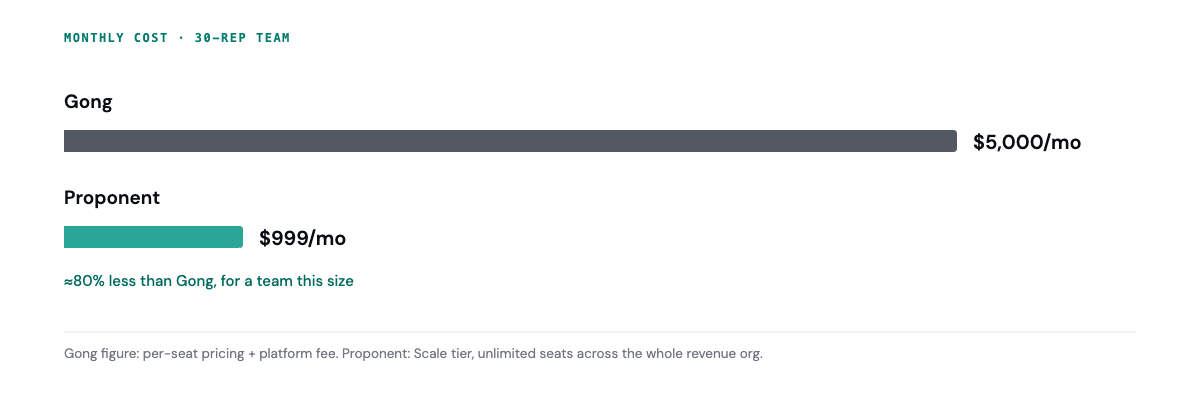
Pricing figures above are accurate as of July 2026 and may change — confirm current rates directly with Gong and Proponent before purchasing.
Which One Should You Choose
Choose Gong if you're running a large enterprise sales org, your average deal size supports a five- or six-figure annual software line item, and you specifically need Gong's Engage sequencing or Forecast modules alongside conversation intelligence.
Choose Proponent if you want deal scoring, rep coaching, and CRM automation running on every call — not just the ones that get reviewed — without paying enterprise per-seat pricing to get there, and without locking your team into a single recorder.
The fastest way to find out which is right for your team: run both against your own calls. Proponent's two-week pilot connects to your existing recorder and CRM in about 15 minutes, with no long-term contract — see the hours it gives back before you decide.
If your team's core need is PMM or competitive-enablement intelligence rather than sales coaching and forecasting, see our comparison of Gong alternatives for product marketing teams.
Frequently asked questions
Can I switch from Gong to Proponent?
Yes. Proponent connects to your existing CRM (HubSpot, Salesforce, Zoho, Attio, Pipedrive) and works alongside whatever recorder or dialer you're already using — including running side-by-side with Gong on the same calls during a pilot, before you decide to switch fully.
Does Proponent replace Gong's coaching and forecasting features?
Proponent covers deal scoring, rep coaching, and CRM automation — the core of what most sales teams use Gong for day to day. It does not include Gong's Engage sequencing module. If sequencing is a hard requirement, factor that into the comparison.
Is Proponent's pricing really per call, not per seat?
Yes. Every plan includes unlimited users across sales, ops, marketing, and leadership; the price scales with call volume, not headcount. Hiring ten more reps doesn't move the bill the way it would under Gong's per-seat model.
How does Proponent's deal scoring compare to Gong's?
Both platforms ground their scoring in call content rather than rep-reported updates. The practical difference is coverage: Proponent scores 99%+ of calls, so coaching and deal health reach every rep and every deal — not just the ones a manager had time to review live.


