Dovetail vs Proponent: Which One Fits Your Workflow?
Dovetail excels at deep research synthesis. Proponent surfaces buyer signals from live sales calls in real time. Here's how to pick the right fit.
 Prashant MohiteCo-founder & CEO6 min read
Teams evaluating Dovetail and Proponent are usually dealing with a similar reality: qualitative insight is everywhere, but clarity is not. Interviews are being conducted, sales calls are recorded, feedback is captured across tools—but turning all of that raw input into decisions that consistently move outcomes becomes increasingly difficult as teams grow.
While both platforms work with customer voice, they are optimized for very different moments in how insight is generated and applied. Understanding those moments—rather than comparing features in isolation—is what ultimately makes the choice between them clearer.
Why Teams Compare Dovetail and Proponent
Both handle qualitative customer insight
At a foundational level, both tools exist to help teams make sense of unstructured data: conversations, notes, transcripts, and feedback that don’t fit neatly into dashboards or spreadsheets. As organizations mature, qualitative insight becomes just as important as quantitative metrics for guiding product, marketing, and GTM decisions.
Because both Dovetail and Proponent sit in this qualitative layer, they often appear interchangeable during early evaluation—even though the type of insight they surface, and the way it’s meant to be used, differs significantly.
Confusion starts when teams scale beyond interviews
The comparison typically emerges when teams move past a small number of interviews or calls. Informal note-taking stops working. Insights become fragmented. Different teams hear different “truths” from customers. At this stage, the challenge isn’t collecting more feedback—it’s deciding which insight should influence which decision, and at what point in time.
That’s where teams start looking for platforms that promise structure, scale, and clarity—and where Dovetail and Proponent enter the same conversation.
When Dovetail Is the Right Choice
Structured qualitative research
Dovetail is built for teams running formal qualitative research. This includes discovery interviews, usability tests, diary studies, and exploratory research where methodological rigor matters. It enables teams to systematically tag data, synthesize themes, and trace insights back to original sources.
This approach is especially valuable when insights need to be defensible, reviewed across stakeholders, and used to inform foundational decisions such as product direction, UX improvements, or long-term positioning.
Long-term research repositories
Another strength of Dovetail is its role as a durable research repository. Over time, teams can accumulate studies, revisit historical findings, and build institutional memory around customer needs and behaviors. This makes it easier to avoid relearning the same lessons repeatedly as teams change or scale.
In short, Dovetail excels when insight depth, continuity, and traceability matter more than immediacy.
If Dovetail itself isn't quite the fit and you're weighing the broader field of research tools, our roundup on Top 10 Dovetail Alternatives for 2026 is worth a look.
When Proponent Is the Right Choice
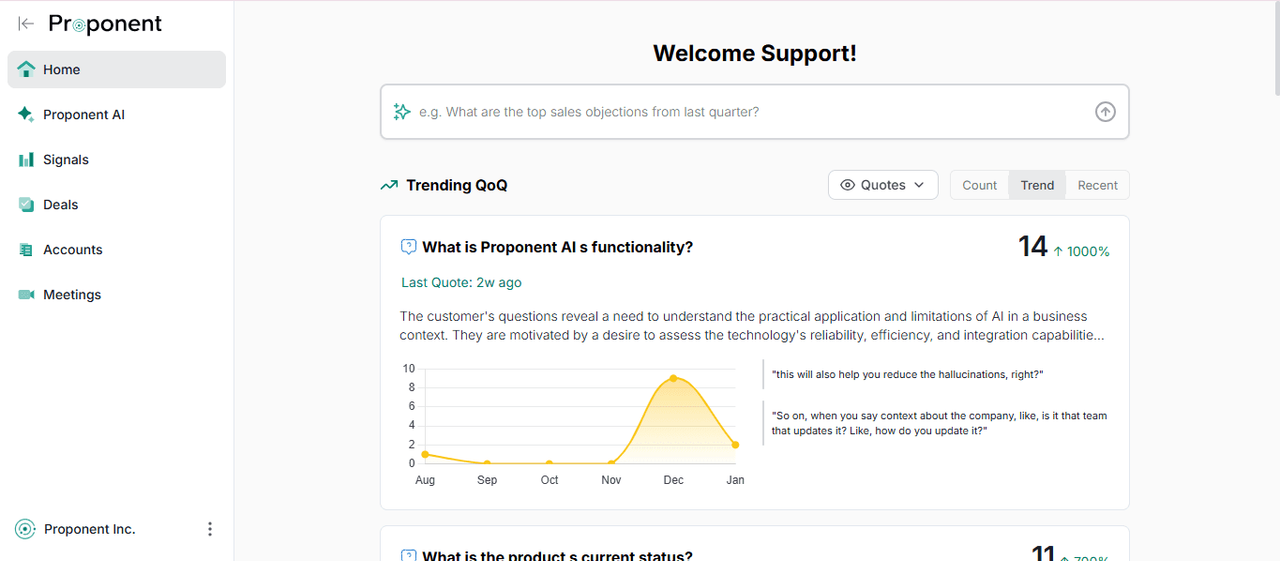
Unlike tools that only tag or analyze transcripts after the fact, Proponent processes sales and customer conversations natively — using audio-based analysis rather than requiring manually uploaded or exported transcripts. And because it sits directly on top of your existing CRM (Salesforce, HubSpot, or Pipedrive), adopting it doesn’t mean ripping out and replacing the systems your team already relies on.
Insight from sales and GTM conversations
Proponent is designed for a different source of insight: live buyer conversations that happen during go-to-market execution. These include sales calls, demos, renewals, and ongoing customer discussions—moments where buyers articulate concerns, urgency, and internal dynamics in their own words.
Unlike structured research, these conversations are continuous and high-volume. They reflect what buyers care about right now, not what they reported during a planned study weeks or months earlier.
Real-time signals for execution
Proponent’s value comes from identifying patterns across these conversations at scale. Instead of relying on memorable anecdotes from a single call, teams can see recurring objections, shifts in buyer language, and early signals of hesitation or momentum across accounts.
Because this insight surfaces while deals are still active, it can directly inform messaging tweaks, enablement updates, and positioning adjustments within the same quarter—when those changes still have leverage.
That kind of live signal is a core piece of what we mean by customer intelligence, a concept we unpack fully in What Is Customer Intelligence? A Complete Guide for B2B GTM Teams.
Key Differences at a Glance
| Dimension | Dovetail | Proponent |
|---|---|---|
| Timing of insight | Surfaces insight after research is completed, synthesized, and shared. This timing is well suited for deliberate planning and long-term decisions. | Surfaces insight while conversations are still unfolding, allowing teams to influence outcomes before they're locked in. |
| Type of output | Produces structured research artifacts such as themes, reports, and documented findings. | Produces behavioral signals—patterns that indicate how buyers are thinking, where they're getting stuck, and why decisions are moving or stalling. |
| Data source | Manually uploaded or exported transcripts, interviews, and surveys | Native audio analysis of live sales and customer calls |
| CRM integration | None — no deal-stage or persona context | Sits directly on top of Salesforce, HubSpot, or Pipedrive |
| Tagging effort | Manual tagging and taxonomy required to structure insights | Automatic pattern detection across conversations, no manual tagging |
| Pricing | Free plan available; Professional $15/user/mo; Business and Enterprise custom pricing | Usage-based, scales with call volume — no per-seat pricing |
Both outputs are valuable, but they serve different purposes.
Pricing figures above are accurate as of July 2026 and may change — confirm current rates directly with Dovetail and Proponent before purchasing.
See what your own calls already reveal: Proponent runs a two-week pilot connected to your existing CRM and call recorder, with no long-term contract.
Which One Should You Choose?
Choose based on the decision you’re supporting
If your primary questions are “What problems should we prioritize?”, “How do users experience this workflow?”, or “What themes emerge across studies?”, Dovetail is a strong fit. If your questions are “Why are deals slowing down?”, “What objections are showing up this month?”, or “How should we adjust messaging mid-quarter?”, Proponent is designed for that context.
Many teams use both
In practice, many teams don’t treat this as an either-or decision. Research platforms inform long-term strategy and foundational understanding. Conversation intelligence tools shape execution and day-to-day judgment. Used together, they help teams avoid reacting too late or relying on isolated anecdotes.
Final Takeaway
Dovetail and Proponent are not substitutes. They are optimized for different moments in the insight lifecycle and support different kinds of decisions.
Teams run into trouble when they expect a single tool to handle both deliberate research and live GTM insight. Clarity comes from matching tools to timing—not from forcing overlap.
The best teams don’t ask, “Which tool is better?”
They ask, “What decision am I trying to support right now?”
Frequently Asked Questions
Can I use Dovetail and Proponent together?
Yes. Many teams run Dovetail for structured research and Proponent for live sales-call signal side by side rather than choosing one over the other — the two inform different kinds of decisions, as outlined above.
Does Proponent require uploading transcripts like Dovetail?
No. Proponent analyzes calls directly from audio, so there's no manual transcript upload or export step required.
Which CRMs does Proponent connect to?
Salesforce, HubSpot, and Pipedrive. Proponent sits on top of your existing CRM rather than requiring you to replace it.
Is Dovetail cheaper than Proponent?
Dovetail's Professional plan starts at $15/user/month, with a free plan available for smaller teams. Proponent is priced by call volume rather than per seat, so the comparison depends on team size — for broad, cross-functional access, usage-based pricing can work out cheaper than paying per seat.
Does Dovetail work with live sales calls?
Dovetail is built for structured research such as interviews and usability tests, and works from manually uploaded or exported transcripts rather than real-time audio analysis of live calls.
Not sure which one fits your team? Book a demo with Proponent and we’ll show you how it layers onto your existing CRM to turn live sales conversations into GTM signal — no rip-and-replace required.
Frequently asked questions
Can I use Dovetail and Proponent together?
Yes. Many teams run Dovetail for structured research and Proponent for live sales-call signal side by side rather than choosing one over the other — the two inform different kinds of decisions, as outlined above.
Does Proponent require uploading transcripts like Dovetail?
No. Proponent analyzes calls directly from audio, so there's no manual transcript upload or export step required.
Which CRMs does Proponent connect to?
Salesforce, HubSpot, and Pipedrive. Proponent sits on top of your existing CRM rather than requiring you to replace it.
Is Dovetail cheaper than Proponent?
Dovetail's Professional plan starts at $15/user/month, with a free plan available for smaller teams. Proponent is priced by call volume rather than per seat, so the comparison depends on team size — for broad, cross-functional access, usage-based pricing can work out cheaper than paying per seat.
Does Dovetail work with live sales calls?
Dovetail is built for structured research such as interviews and usability tests, and works from manually uploaded or exported transcripts rather than real-time audio analysis of live calls.


