A Practical GTM Stack for 2026: Tools Teams Use to Understand Buyer Behavior
How modern GTM teams are moving from simply tracking activity to actually interpreting buyer decisions, and the practical tool stack that makes it possible.
 Prashant MohiteCo-founder & CEO5 min read
Go-to-market teams today are not struggling because they lack tools. They are struggling because their tools are optimized for tracking activity, not understanding decisions. CRMs show stage movement, dashboards report engagement, and workflows automate execution, yet teams are often left guessing why some deals accelerate while others stall without warning.
As buying processes become more complex and involve multiple stakeholders, this gap between activity and understanding becomes more expensive. High-performing GTM teams heading into 2026 are responding by becoming far more intentional about their stack. Instead of adding more software, they are choosing tools that help them interpret buyer behavior, connect insights across teams, and reduce dependence on intuition or isolated anecdotes.
The tools below represent categories that modern GTM teams rely on to support conversation-led strategy and clearer decision-making. This is not a ranking or a comparison guide. It is a practical view of how teams are structuring their GTM stack around understanding, not just execution.
Tools GTM Teams Are Relying On Going Into 2026
1. Proponent — Conversation Intelligence & Buyer Behavior
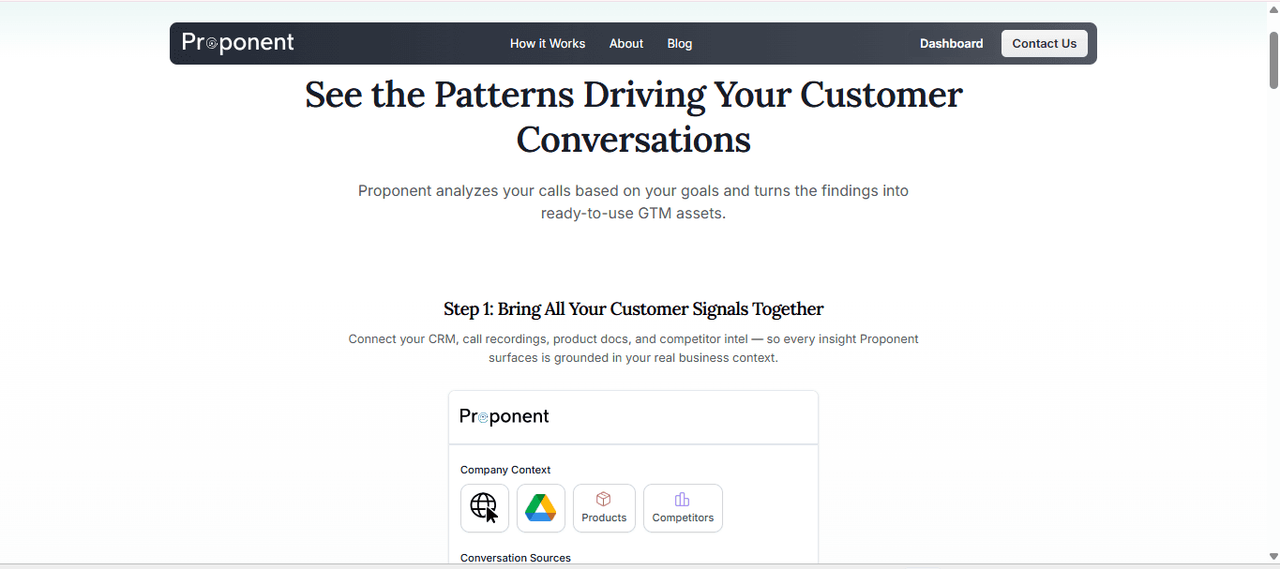
Proponent sits at the layer where buyer decisions actually take shape: conversations. Sales calls, interviews, demos, and customer discussions contain the richest signals of intent, hesitation, and momentum, yet these signals are often lost once calls end. Proponent analyzes conversations at scale to surface behavioral patterns across accounts, helping PMMs and GTM teams understand why deals move forward, stall, or disengage. Instead of focusing on individual call summaries, it identifies recurring decision signals that inform messaging, positioning, enablement, and GTM strategy.
2. Gong — Sales Call Recording & Deal Visibility
Gong provides visibility into how sales conversations are executed across the pipeline. By recording and analyzing calls, it helps teams understand deal progression, coaching opportunities, and execution gaps. While Gong focuses primarily on sales performance and deal-level outcomes, it plays an important role in anchoring conversations to pipeline movement and revenue impact.
3. Condens — Qualitative Research Analysis
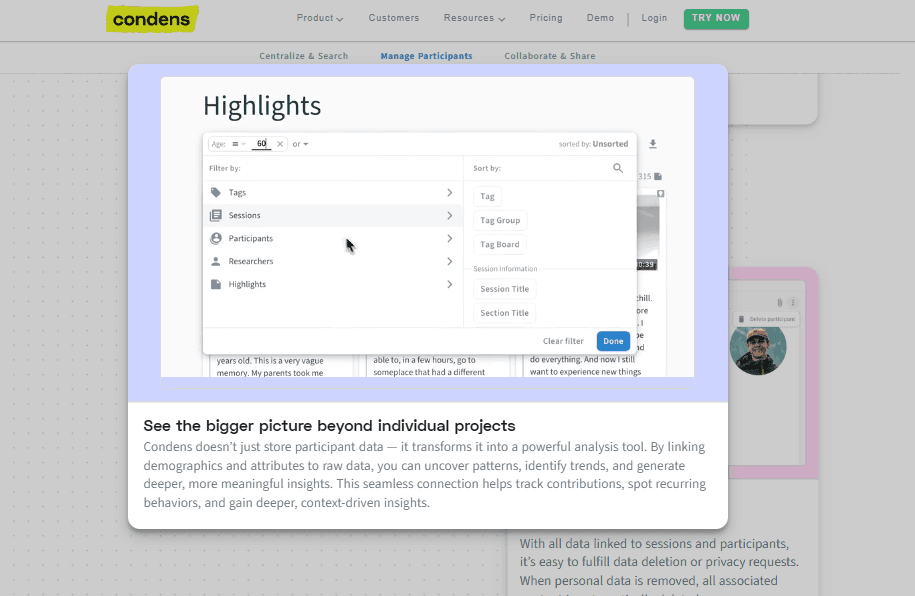
Condens supports structured analysis of qualitative research, helping teams move beyond isolated interview notes. It enables tagging, synthesis, and cross-project analysis so teams can identify patterns across studies rather than relying on individual anecdotes. Condens is often used by research and product teams whose insights feed into GTM decisions around messaging and positioning.
4. Marvin — Research Repository & Synthesis
Marvin provides a structured environment for managing customer research through live note-taking, tagging, and AI-assisted synthesis. It is commonly used by teams that want to maintain organized research workflows while reducing manual effort. By making research insights easier to retrieve and reuse, Marvin helps ensure qualitative input remains relevant to GTM strategy over time.
5. EnjoyHQ — Voice of Customer Aggregation
As organizations scale, customer feedback begins to arrive from many sources, including sales, support, surveys, and internal notes. EnjoyHQ centralizes this feedback into a single system, allowing teams to analyze Voice of Customer patterns holistically. This reduces fragmentation and supports better cross-functional alignment around what customers are consistently saying.
If you're trying to place VOC aggregation within the bigger GTM picture, our guide on What Is Customer Intelligence? A Complete Guide for B2B GTM Teams walks through the full discipline.
6. HubSpot — CRM & GTM Context

HubSpot continues to serve as the system of record for many GTM teams, tracking deals, accounts, and lifecycle stages. While CRMs do not explain buyer intent on their own, they provide essential context for where conversations and insights sit within the broader funnel. HubSpot anchors qualitative insight within measurable GTM motion.
7. Freckle.io — CRM Enrichment & Data Hygiene
Accurate data is foundational to effective GTM decision-making. Freckle.io helps enrich CRM records with firmographic and account-level information, reducing data decay and blind spots. By improving data quality, it enables clearer prioritization and more reliable analysis across GTM teams.
8. RB2B — Website Visitor Identification
Not all buying interest appears through inbound forms. RB2B helps identify anonymous website visitors at the account level, giving teams early visibility into interest before buyers formally convert. This supports earlier outreach and better timing in GTM motions.
9. Trigify — External Buyer Intent Signals
Buyers also signal intent outside of owned channels through social engagement and external activity. Trigify captures these signals, helping teams identify early buying behavior that may not yet be visible in pipeline or CRM data. When combined with conversation insight, these signals add important context to GTM decisions.
10. Clay — GTM Data Orchestration
As GTM stacks grow, connecting data across tools becomes increasingly complex. Clay acts as an orchestration layer that allows teams to combine enrichment, intent signals, and workflows into a single system. This reduces manual work and helps ensure insights flow to the right teams at the right time.
11. Zapier — Workflow Automation
Zapier supports GTM and RevOps teams by automating repetitive workflows and connecting tools across the stack. While not GTM-specific, it plays a key role in keeping operations efficient and reducing friction between systems.
12. Sybill — AI Meeting Notes & Summaries
As meeting volume increases, retrieving context becomes harder. Sybill automatically summarizes meetings and calls, helping teams quickly recall key information without rewatching recordings. This supports continuity across fast-moving GTM teams.
For teams drowning in call volume rather than meeting notes, we cover exactly this challenge in How to Surface Insights From 100s of Sales Calls Without Listening to All of Them.
Final Thoughts
The GTM stack heading into 2026 is evolving from a pure execution engine into a system for understanding buyer behavior. Competitive advantage no longer comes from tracking more activity, but from interpreting signals more accurately and consistently across teams.
The most effective GTM teams are not replacing their entire stack. They are ensuring that each tool earns its place by contributing to clarity—helping teams understand why buyers decide the way they do, not just what happened after the fact.
If your GTM stack is missing the conversation-intelligence layer, that's exactly where Proponent fits—book a demo to see it in action.


