How RevOps Uses Conversation Intelligence to Fix CRM Data Quality
The average CRM is 35% complete because reps log deals from memory, days later. Here's why "just fill in the field" doesn't work, and what actually fixes it.
 Bhumika GohilHead of Revenue6 min read
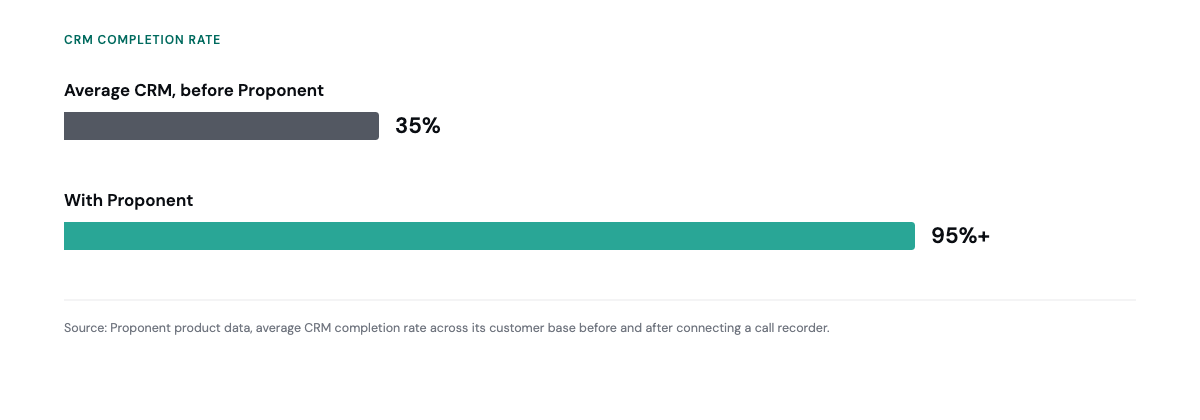
CRM data quality is a RevOps ownership problem, not a rep-discipline problem. Reps log deals from memory, usually days after the call, and memory decays faster than any nagging campaign fixes it. Conversation intelligence closes that gap by writing CRM fields directly from the call itself, the same day, from what was actually said rather than what a rep remembers by Friday. Proponent's own data across its customer base shows this moves the average CRM from 35% complete to 95%+, without asking reps to log anything at all.
Why Is RevOps Always Fighting the Same CRM Data Problem?
Every RevOps team inherits the same complaint, on a loop: the CRM doesn't reflect what's actually happening in the pipeline. Deal stages sit stale. Next steps are missing or three weeks old. Competitor fields are blank on deals where a competitor clearly came up, because someone would have had to type it in. Forecasts get built on records nobody trusts, so forecast calls turn into oral corrections of the CRM instead of a read of it.
The usual response is more process: a new required field, a validation rule that blocks stage advancement, a Slack reminder before Friday's pipeline review, a scorecard that dings reps for CRM hygiene. All of it targets the same lever, rep behavior, and all of it produces the same short-lived bump. Compliance spikes for two weeks after the nag, then drifts back down, because the underlying problem was never rep effort. It was timing.
Why Doesn't "Just Fill In the Field" Work?
A rep who just spent 40 minutes on a call moves straight into the next one, then the next, then a stack of Slack messages and a pipeline review. By the time they open the CRM record, often a full day or more later, they're not transcribing the call. They're reconstructing it from memory, and memory is lossy in a predictable direction: the parts that felt important in the moment survive, and the specific parts, the exact budget number, the name of the competitor that came up once, the precise wording of an objection, don't.
This isn't a motivation problem. It shows up even on teams with strong CRM discipline and real accountability, because the failure happens before the rep ever opens the CRM. Across Proponent's customer base, the average CRM sits at 35% complete before any intervention, and managers review roughly 2% of calls, which means almost none of that gap ever gets caught and corrected. Nobody is watching closely enough to know which 65% is missing, let alone why.
Required fields and validation rules don't fix this either. They just move the failure point: a rep facing a blocked stage advancement will type something into the required field to get past it, not necessarily the accurate thing. A CRM record that's 100% filled in and 35% accurate is arguably worse than one that's honestly incomplete, because it looks trustworthy in a pipeline review right up until it isn't.
What Does Conversation Intelligence Actually Change?
The fix isn't a better nag. It's moving the point of data capture from "after the call, from memory" to "during the call, from the transcript." Conversation intelligence tools listen to the call itself and extract structured fields directly from what was said: budget mentioned, competitor named, objection raised, next step agreed on. None of that depends on a rep's memory or willingness to type, because none of it happens after the call anymore.
That's a different category of fix than most of what gets marketed as "AI for RevOps." A lot of that tooling is still built to help reps log faster, a smarter form, a better autocomplete, a nicer mobile app for CRM entry. It's still asking a human to reconstruct the call from memory, just with a friendlier interface. Conversation intelligence skips the reconstruction step entirely. That's why it holds up even on teams where reps aren't being negligent, they just don't have five extra minutes per call, because the day is already full.
This is the same underlying idea covered in more depth in what customer intelligence actually is as a discipline: treating every conversation as a data source in its own right, rather than a thing a human has to translate into data after the fact. CRM hygiene is one specific, high-stakes application of that same shift.
What Should RevOps Automate First?
Not every field is worth automating on day one, and trying to do all of it at once is how these rollouts stall.
Start with the fields that actually move a forecast: budget, timeline, decision process, competitor mentions. These are also the ones reps forget fastest, because they're specific numbers and names rather than general impressions. Next-step tracking comes second, and it's more than logging what was agreed on. The real win is assigning the follow-up task to the rep automatically, so it exists before they're even back at their desk instead of depending on someone to write it down later. Objection and competitor tracking can wait. It matters for coaching and win-loss analysis, but it doesn't move a forecast the way the first two do, so it's a reasonable place to expand once the core fields are landing reliably.
Before automating any of it, ask which CRM fields RevOps actually pulls into forecast reviews and QBRs today. Automate those first. A field nobody looks at doesn't need to be accurate, it needs to not exist. If it's useful to see this mapped against an actual CRM and call stack rather than in the abstract, a short pilot is usually a faster way to find out than a slide deck.
How Do You Measure Whether It's Working?
CRM completion rate is the honest top-line metric, and it's worth tracking before and after rather than trusting a vendor's general claim about it. Across Proponent's customer base, CRM completion moves from an average of 35% before to 95%+ within the first few weeks of connecting a call recorder, without any change in rep behavior, because the fields are being filled from the call transcript rather than from a rep's memory.
A few supporting metrics are worth watching alongside it. The percentage of deals with a next step logged within 24 hours of the call is a good proxy for whether follow-up actually happens on time, not just whether a field is technically filled in. Forecast variance quarter over quarter is the real test, since the entire point of CRM data quality is a forecast RevOps can trust without a manual gut check. And call coverage, what percentage of calls actually get reviewed or contribute structured data, matters against that 2% baseline most teams start from.
None of these move because reps got better at logging. They move because the data stopped depending on a rep remembering to log it at all. That's the thing to check for in any RevOps tool, not just this one. If the pricing math on doing this across a full rep team is the open question, the per-rep cost breakdown answers it.
CRM completion is one input into a bigger question RevOps eventually has to answer: whether the tool paid for itself. How RevOps builds an ROI report it can defend in a budget review covers that fuller measurement, win rate, rep capacity, and payback period, not just CRM completion on its own.
Frequently asked questions
What counts as "CRM data quality" for RevOps, specifically?
Field completeness, accuracy, and timeliness, together. A record can be 100% filled in and still low quality if the values are guessed from memory rather than what was actually said on the call, and a record filled in three weeks late is functionally incomplete for forecast purposes even once it's technically there.
Does conversation intelligence replace CRM fields entirely, or just fill them in?
It fills the existing fields in your CRM directly, it doesn't replace your CRM or require a new system of record. The CRM stays the system of record; the difference is where the data in it comes from, extracted from the call rather than typed from memory.
How is this different from CRM validation rules or required fields?
Validation rules and required fields control whether a field gets filled in, not whether what's typed into it is accurate. A rep blocked by a required field will still enter something to get past it. Conversation intelligence changes what goes into the field in the first place, sourced from the transcript instead of from whatever a rep remembers under deadline pressure.
Which CRM fields does conversation intelligence update automatically?
Typically the fields that come up explicitly in conversation: competitor mentions, budget and timeline details, objections raised, decision-process notes, and next steps, with a follow-up task assigned to the rep automatically. Fields that require judgment calls outside the call itself, like a stage change tied to internal deal review, usually stay a human decision.
How long does it take to see CRM completion improve?
Because the fields populate from calls as they happen rather than through a change in rep behavior, most teams see completion rates move within the first few weeks of connecting a call recorder, not after a quarter of change management.
Does this work with an existing recorder and dialer stack?
Yes, this is designed to sit on top of whatever call recording and dialer setup a team already has rather than requiring a swap, since the value is in what happens to the transcript after the call, not in how the call itself gets captured.


